
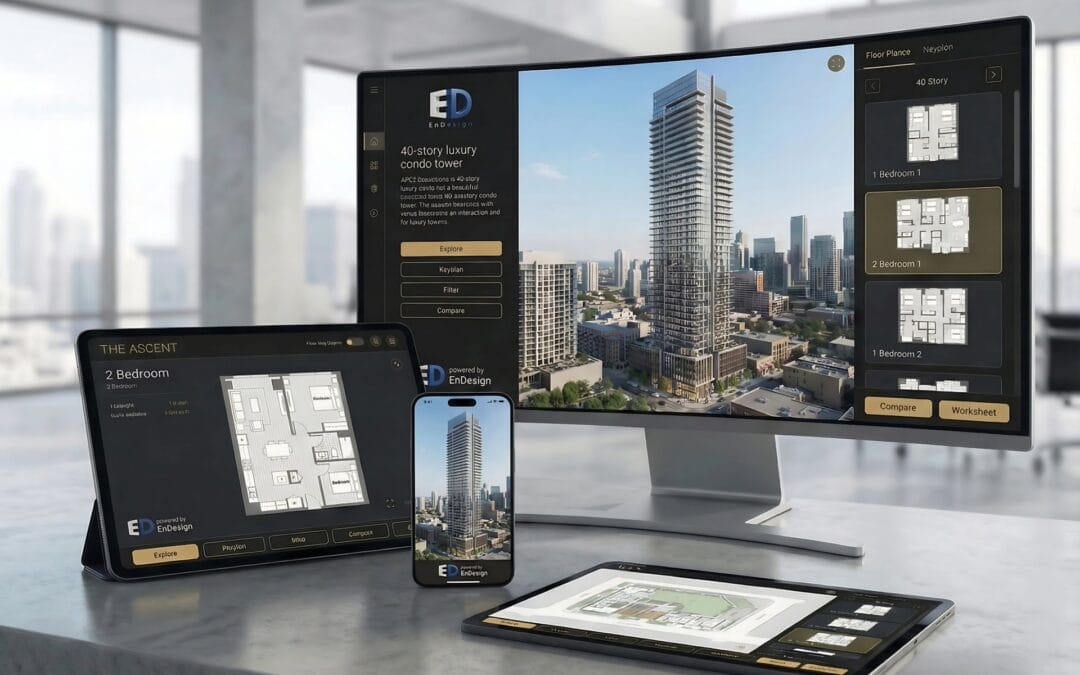
A 3D model represents how something is built. A digital twin represents how one specific real asset is behaving right now, because data reaches it automatically. Between the two sits the category most projects actually need: interactive, real-time 3D applications that people navigate, configure and query, but that are not synchronized with live sensor data. Knowing which of the three your project requires decides both the brief and the budget.
Key Takeaways
- There are four levels, not two: a static 3D model, an interactive real-time 3D application, a digital shadow with one-way live data, and a digital twin with two-way synchronization.
- The defining feature of a digital twin is automatic data flow between a specific physical asset and its digital representation, not visual quality or interactivity.
- Interactive 3D applications are often mistaken for digital twins. They are a distinct and valuable deliverable in their own right, without a twin’s ongoing data obligations.
- EnDesign builds the 3D and interactive visualization layer across all four levels. We do not install sensors or build data infrastructure, which sits with a systems integrator or an in-house team.
- The practical test for a twin: ask what happens to the digital version when the real asset changes, and whether anything the digital version calculates can act on the asset.
What is a 3D model?
A 3D model is geometry with information attached. It describes shape, dimension, material and position, and it may be created in Revit, SketchUp, Rhino, 3ds Max, Blender or a CAD package. It can be rendered to photorealistic quality or left as simple massing.
A model represents a chosen state: the building as designed, the product as specified, the site as surveyed. If the real thing changes, the model does not know, because updating it is a human task.
That is not a shortcoming. For most commercial purposes it is exactly what is required. A rendering sells a development before it exists. A product visual supports a launch before tooling is cut. A massing study tests a planning scenario. None of these would be improved by a live data feed, because the subject either does not exist yet or is not changing.
This is the foundation of most of our work, across 3D architectural rendering and 3D animation.
What is an interactive 3D application?
This is the level that gets missed, and it is where many projects actually land. An interactive 3D application is a real-time environment a user controls: they move through it, change options, filter what is displayed and query what they are looking at.
Product configurators, interactive site plans, unit selectors, navigable CGI environments and VR walkthroughs all sit here. They are built in real-time engines rather than offline renderers, because frames have to be produced in response to input rather than prepared in advance.
An interactive application can display data. A unit selector can show live availability pulled from a sales system, and a site plan can color floors by status. That does not make it a digital twin, because the data describes a commercial process rather than synchronizing the application with the physical state of a built asset.
The distinction matters commercially. An interactive application is a deliverable: it is produced, launched and maintained like normal software. A digital twin is a system with a continuous data obligation behind it.
Our work at this level sits on the interactive 3D platforms and applications and 3D product configurator pages.
What is a digital twin?
The Digital Twin Consortium defined a digital twin in 2020 as a virtual representation of real-world entities and processes, synchronized at a specified frequency and fidelity. The key word is synchronized: a twin is bound to one specific real asset and receives data from it on an ongoing basis.
In manufacturing, ISO 23247-1:2021 expresses the same principle differently, describing a fit-for-purpose digital representation of an observable manufacturing element, kept in step with it at an appropriate rate of synchronization.
Both definitions place the weight on the connection rather than on the model. A twin can be visually plain and still be a twin. A photorealistic interactive environment with no live feed is not one, however sophisticated it is.
What are the four levels?
A widely cited 2018 classification by Kritzinger and colleagues separates digital models, digital shadows and digital twins by how data moves between the physical and digital versions. The table below places interactive applications within that framework, since they are the level most commercial projects occupy.
| Level | How data flows | Typical example | Is it a twin? |
|---|---|---|---|
| Static 3D model | Manual. A person updates it when something changes | Architectural rendering, product visual, massing study | No |
| Interactive 3D application | Manual or business data; no synchronization with physical state | Configurator, unit selector, CGI virtual tour, VR walkthrough | No |
| Digital shadow | Automatic from physical to digital only | Live sensor readings displayed on a 3D model of a building | No |
| Digital twin | Automatic in both directions | A system that reads occupancy and adjusts ventilation | Yes |
Each level is legitimate, and each costs more than the one above it. A digital shadow in particular is often the sensible destination: it delivers monitoring value without the control integration, commissioning and safety review that a closed loop requires. Under this classification, many products marketed as digital twins are more accurately described as digital shadows, which is a comment on terminology rather than on their usefulness.
What makes a twin a twin? Four tests
- Does it have a specific physical counterpart? A twin corresponds to one real asset. A model of a building type is not a twin of any particular building.
- Does data arrive automatically? If someone exports a file and uploads it, that is manual updating. A twin receives data through a pipeline.
- Does it reflect current state? A twin tells you what is true now, within its specified synchronization frequency, rather than what was true when it was last edited.
- Can it act, or at least be trusted enough to act on? Full twins send instructions back to the asset. At minimum, decisions are made directly from what it reports.
Anything failing tests two and three is a 3D model or an interactive application with a data display, regardless of how a proposal describes it.
Where does EnDesign fit?
We are a 3D visualization and interactive applications studio. Across these four levels, our scope is consistent: we build the geometry, the real-time environment, the interface and the interaction design. That is the layer people actually see and use.
| Level | What we deliver | What sits with others |
|---|---|---|
| Static 3D model | Full delivery: modeling, materials, lighting, rendering, animation | Nothing |
| Interactive 3D application | Full delivery: real-time build, interface, configuration logic, deployment | Integration with your CRM or sales systems, where required |
| Digital shadow | The 3D environment and interface that displays the data | Sensors, gateways, data platform and point mapping |
| Digital twin | The visualization layer: spatial model, interface, VR or web delivery | Sensors, data pipeline, analytics, control integration |
We do not install sensors, build data infrastructure or author BIM models. On a digital twin project we work alongside the systems integrator or in-house team who own those layers. More on our side of that work is on our digital twin solutions page.
When is a model or an interactive application the better choice?
- The asset does not exist yet. Pre-construction marketing, design testing and planning submissions all need a model, because there is nothing to synchronize with.
- The asset is not instrumented. Without systems reporting data, there is no feed to connect, and adding instrumentation is a separate capital project.
- The requirement is exploration rather than monitoring. Letting someone configure a product, compare finishes or walk a space is an interactive application, not a twin.
- There is no recurring operational decision, or nobody will own the system. A twin with no accountable owner drifts out of step with its asset.
Frequently asked questions
Is a photorealistic render a digital twin?
No. Visual quality has no bearing on the classification. A render shows a chosen state with no connection to a real asset. A digital twin may look far simpler and still qualify, because it is synchronized with something physical.
Is an interactive 3D application a digital twin?
Not by itself. Interactivity means a user controls the view; synchronization means the representation tracks a real asset automatically. An application can display live business data, such as unit availability, and still not be a twin in the technical sense.
Can a 3D model become a digital twin later?
It can become the visualization layer of one. The geometry is reusable, though models built for construction usually need simplifying for live performance. The data pipeline, point mapping and interface are new work.
Does a digital twin need 3D geometry at all?
No. Many industrial twins are purely data models. Geometry matters when the people using the twin need spatial context to interpret what they are seeing, which is usually the case for buildings, facilities and products.
Working out which one your project needs. Start from what the output has to do. If it has to show or sell something, you need a model or an interactive application, and that is the whole project. If it has to report the live state of a real, instrumented asset, you are scoping a twin, and the visualization is one layer of several.
Tell us what you are trying to achieve through our contact page, or see examples of our work in our portfolio.
Get a Quote
Tell us about your project and our team will reply quickly.
Prefer to talk? Call 1-844-736-3379