A CGI virtual tour lets people explore a space that may not exist yet. An interactive 3D application lets them configure it, filter it and query it. A digital twin adds live operational data from a real, instrumented building. All three are built on the same 3D foundation, and many requests that begin with “we need a digital twin” are better served by one of the first two.
Key Takeaways
- A CGI virtual tour can be produced for a building that has not been constructed. A digital twin cannot, because it requires a real asset to synchronize with.
- Interactive 3D applications sit between the two: navigable and queryable, often showing live business data such as unit availability, without synchronizing with physical state.
- Tours and interactive applications are deliverables with predictable costs. A twin is a system with a continuing data obligation.
- The three are not mutually exclusive, and a tour-style interface is a common way to navigate a twin.
- EnDesign builds CGI tours, interactive applications and the visualization layer of digital twin projects.
What is a CGI virtual tour?
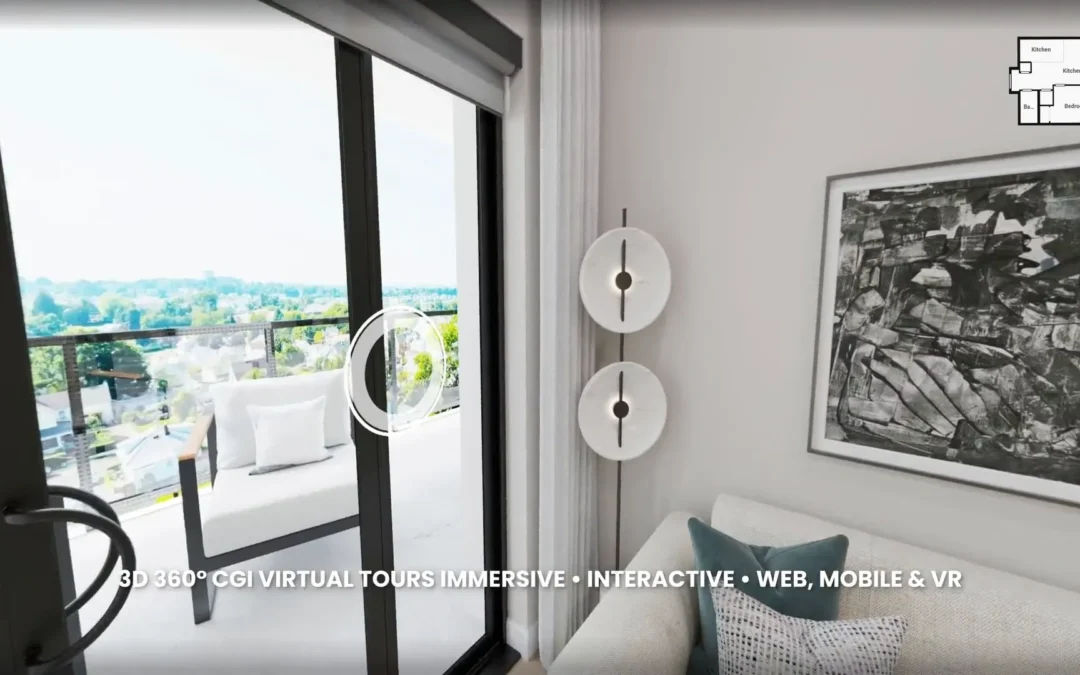
A CGI virtual tour is a navigable environment built from architectural drawings rather than captured from a real space. Users move between viewpoints, look around, open hotspots and, in richer builds, switch finishes or lighting conditions.
The defining advantage is that the building does not need to exist. For pre-construction sales, a CGI tour is often the only way to let a buyer experience a suite months or years before handover, and it can show the space furnished, finished and in the lighting that presents it best.
A second advantage is control. Because every element is modeled, a CGI tour can show variants: different finish packages, different furniture schemes, day and evening conditions. Capture-based tours record what was physically there on the day.
Our 3D virtual tours service covers this work, and there is more background in What Is Interactive 3D Real Estate and Why Is It the Future?
What is an interactive 3D application?
An interactive 3D application extends a tour from exploration into interrogation. Rather than only moving through a space, users filter, compare, configure and query it.
Common forms include unit selectors that filter available suites by floor, price and exposure; interactive site plans that color buildings by phase or status; product configurators that let a customer change materials and options on a live model; and view-from-suite tools that show what a buyer would actually see from a specific floor.
These applications often display live data. A unit selector can reflect availability from a sales system in real time. That is genuinely useful and still not a digital twin, because the data describes a commercial process rather than the physical state of a built asset.
This work sits on our interactive 3D platforms and applications and product configurator pages.
What is a digital twin?
A digital twin is a virtual representation of a real asset, synchronized with it at a specified frequency and fidelity, to use the Digital Twin Consortium’s 2020 definition. It receives operational data automatically and reflects current state rather than a captured or designed condition.
Twins exist to support decisions made repeatedly: whether equipment needs attention, which floors are under-occupied, where energy is being wasted. Those decisions need current information, which is why synchronization is the defining requirement.
How do the three compare?
| CGI virtual tour | Interactive 3D application | Digital twin | |
|---|---|---|---|
| Asset required | None, works pre-construction | None, works pre-construction | A real, instrumented asset |
| What it shows | A space as designed | A space plus options and business data | A space plus live operational state |
| Primary buyer | Marketing, sales, leasing | Sales, product, marketing | Facilities, operations, asset management |
| Data | Fixed at production | Often live business data | Continuous feed from building systems |
| Ongoing cost | Hosting; updates if the design changes | Hosting, maintenance, system integration | Data pipeline, mapping, ownership, integration |
| Main risk | Becoming out of date visually | Integration drift with source systems | Drifting out of sync and still being trusted |
Why do the terms get confused?
Several capture platforms describe their output as a digital twin, and that language has shaped how buyers use the term. A navigable, dimensionally accurate scan of a real building is a useful product and considerably more than a photo gallery. Under the standard definitions it is still a virtual tour, because no operational data flows into it and it does not reflect anything that changes after the capture date.
This matters when comparing proposals. Two suppliers can both say “digital twin” while quoting for very different work at very different prices. One question separates them: what data feeds this after delivery, and how often? If the answer is none, the deliverable is a tour or a scan, which may be exactly right for the purpose.
Which one do you need?
- Does the asset exist, and is it instrumented? If it is unbuilt or has no systems reporting data, a twin has nothing to synchronize with. A CGI tour or an interactive application is the available route.
- Is the audience external or internal? Buyers, tenants, investors and the public are almost always served by a tour or an interactive application. Internal operations teams may need a twin.
- Is the task exploration or monitoring? Showing, selling and configuring are tour and application work. Monitoring a live asset is twin work.
- Will somebody own it in a year? A tour needs no owner beyond hosting. A twin without an accountable owner drifts out of step with the asset.
If the answers point to a tour or an interactive application, that is usually the lower-cost route, with no continuing data obligation.
Can you combine them?
Yes. A tour-style navigation interface is an intuitive way to move through a twin, because people understand walking through a building better than reading a plan with data overlaid.
The important point is that the interface is not what makes something a twin. You can navigate a twin like a tour and build a tour that resembles a twin. What separates them sits behind the interface.
A sensible sequence for many organizations is to start with a CGI tour or an interactive application, which delivers immediate marketing value, and build toward a twin later if an operational case emerges. The geometry produced for the first can usually be reused. Our digital twin solutions page explains the visualization work we provide when that time comes.
Frequently asked questions
Is a capture-based scan a digital twin?
A scan produces a navigable, dimensionally accurate record of a real space, which is valuable. Under the standard definitions it is a virtual tour, because no operational data flows into it after capture and it does not reflect later changes.
Can a virtual tour be made before a building exists?
Yes. CGI tours are built from architectural drawings and are standard in pre-construction marketing. This is the clearest advantage a CGI tour has over both capture-based tours and digital twins, which each require a real asset.
Which costs more?
A digital twin, and the gap widens over time. A tour is a one-time production with hosting costs. A twin carries data integration, ongoing pipeline maintenance, re-mapping when systems change and an owner’s time indefinitely.
Can a virtual tour be upgraded later?
CGI tours extend well, because the underlying model is structured and reusable. Capture-based tours are harder to extend, since a point cloud is less straightforward to structure for data binding.
Working out what fits your project. The question worth answering first is who will use the output, how often, and to decide what. That usually makes the choice obvious, and it often saves a significant amount of budget.
Tell us what you are trying to achieve through our contact page, and see our work in our portfolio.
Get a Quote
Tell us about your project and our team will reply quickly.
Prefer to talk? Call 1-844-736-3379